Levels of Differentiation
Murray Bowen's concept of self-differentiation—the ability to separate feelings from thoughts and remain an individual within a volatile emotional system.
Self-Differentiation is a foundational concept in Murray Bowen's Family Systems Theory. It describes a person's capacity to separate their intellectual functioning from their emotional reactivity, and to maintain a distinct, independent sense of self while remaining emotionally connected to their family system. In families dominated by emotionally immature people (EIPs), differentiation is actively discouraged, as the system demands emotional fusion to maintain control.
The Two Dimensions of Differentiation
Differentiation operates on two levels:
- Intrapsychic: The ability to distinguish between your thoughts (logic, values) and your immediate feelings (fear, anger, reactivity). A highly differentiated person can feel a strong emotion without being ruled by it or acting impulsively.
- Interpersonal: The ability to distinguish between your own emotional state and the emotional state of those around you. It is the capacity to say, "You are upset, but I am calm," without absorbing their anxiety.
Three Relational Postures in the Family System
Bowen's framework highlights three distinct stages or postures that individuals adopt when navigating family emotional currents:
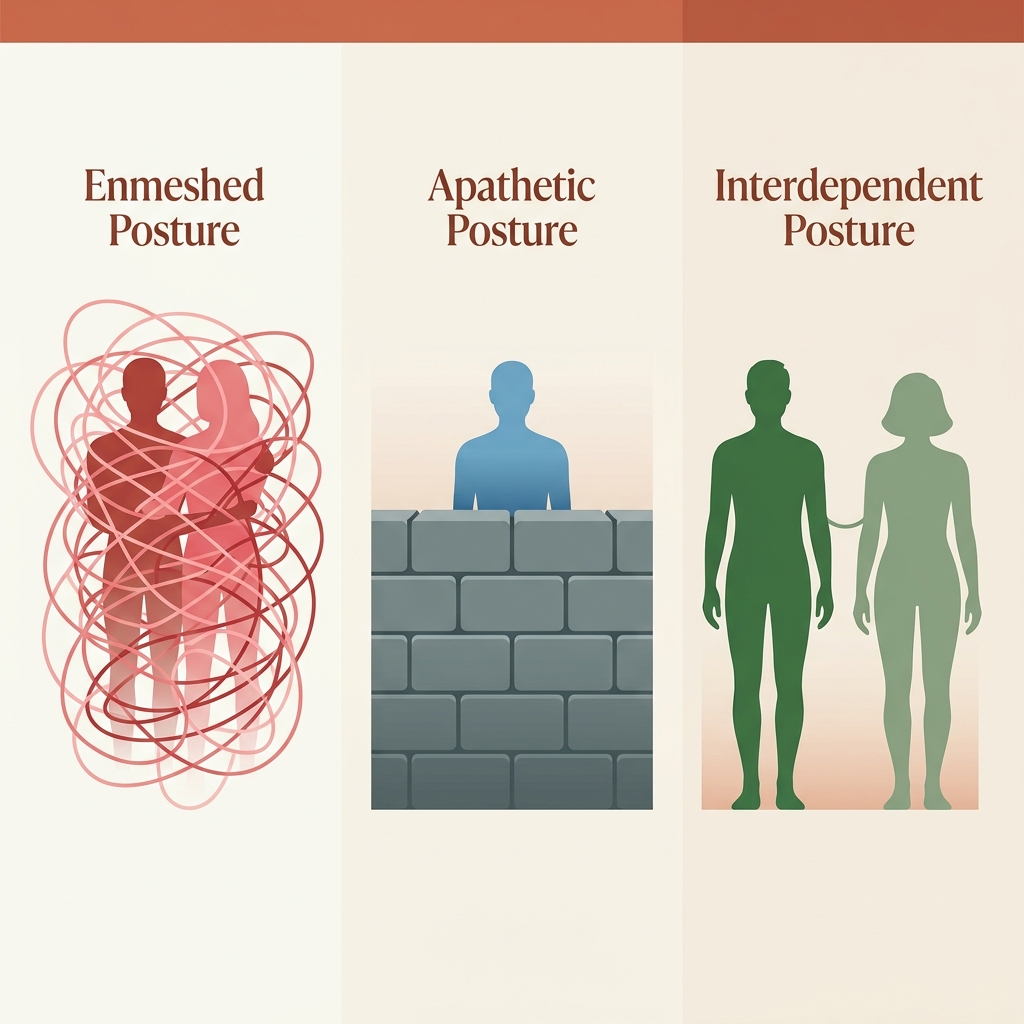
1. Enmeshed (Fused / Loss of Self)
At low levels of differentiation, boundaries dissolve entirely. In an enmeshed state, a person's emotional state is hostage to the family's temperature. If a parent is angry or anxious, the enmeshed child immediately absorbs that anxiety and feels a desperate need to fix it. Autonomy is viewed as disloyalty, and individual thoughts are abandoned to maintain the system's peace.
2. Apathetic (Counter-Dependent / Emotional Cut-Off)
Often confused with healthy boundaries, apathy or counter-dependence is a desperate, protective shield. When the pressure to fuse becomes intolerable, an individual may shut down emotionally, withdraw completely, or adopt a cold, "I don't care" attitude. While they appear independent, they are actually highly reactive; their coldness is a defensive posture designed to keep the system from swallowing them.
3. Interdependent (True Differentiation)
Interdependence is the healthy, mature goal of the healing journey. A highly differentiated person can remain intimately connected to their family, showing love and support, without losing their sovereignty. They can hold onto their own values, opinions, and peace of mind even in the midst of a family storm. They do not need to rescue, nor do they need to run away; they are anchored in their true self.
Kim's Thoughts
"lorem ipsum"