Emotional Composition
Robert Plutchik's 8 primary emotions, and the toxic danger of emotional dis-composition: how suppressing one pillar causes systemic tension, dysregulation, and depression.
In clinical psychology, an integrated and healthy emotional landscape is built on the complete, balanced composition of our primary feelings. According to psychologist Robert Plutchik’s evolutionary theory of emotion, there are 8 primary emotions that serve as the biological foundations of human survival:
- Joy and Sadness
- Anger and Fear
- Trust and Disgust
- Surprise and Anticipation
In a fully functional self, these eight pillars exist in a state of dynamic composition, blending together to guide our self-preservation and boundaries. However, in systems run by emotionally immature parents (EIPs), children are forced into a highly dangerous state of Emotional Dis-composition.
The Danger of the "Scratched-Out" Petal
Emotionally immature parents cannot handle emotional complexity or tolerate feelings that challenge their fragile egos. As a result, certain primary emotions are classified as "illegal" in the household:
- Sadness is dismissed as dramatic or weak.
- Anger is punished as disloyalty or rebellion.
- Disgust (somatic rejection) is shamed as pickiness.
To survive and maintain attachment to their caretakers, the child must perform a form of psychological amputation, actively desaturating or "scratching out" these forbidden petals from their emotional wheel.
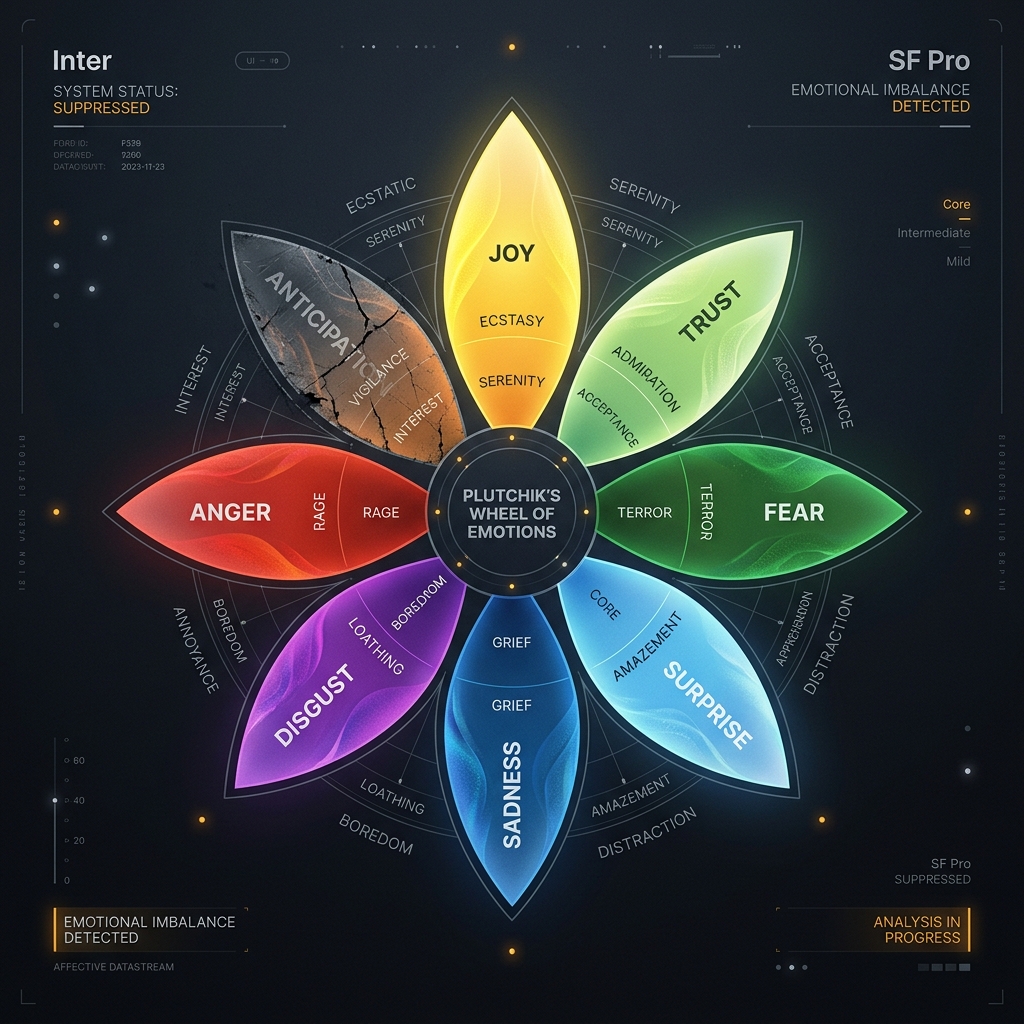
When entire segments of your emotional wheel are scratched out, your psychological balance collapses. You are forced to live in a state of chronic enmeshment, pretending to feel only the "safe" emotions (Joy and Trust) while your true, authentic primary signals are buried alive.
The Beach Ball Analogy of Suppression
Suppressing a primary emotional pillar does not make it disappear. Instead, it does the psychological equivalent of holding an inflatable beach ball underwater.

Holding the ball under the surface requires constant, exhausting, and active force. The deeper and harder you push it down to keep it hidden, the more buoyant, explosive pressure accumulates in the background.
Your conscious mind can only hold the ball down for so long. The moment your grip slips—due to physical exhaustion, stress, or a minor adult trigger—the beach ball erupts violently out of the water, crashing through your defenses. This explains why adult children of EIPs often experience sudden, massive eruptions of rage or panic that seem completely out of proportion to the current situation; it is the compressed pressure of a childhood beach ball finally escaping your grip.
The Downstream Fallout of Dis-composition
When you are forced to live with a dis-composed emotional wheel, your system suffers three primary consequences:
- Relational Subversion and Conversion: The high-pressure, suppressed emotion leaks into and subverts the other pillars. Unexpressed sadness and grief convert into chronic, irritable anger; unexpressed anger at being neglected converts into toxic shame or somatic panic.
- Severe Dysregulation: The nervous system loses its capacity for gentle regulation. You swing wildly between emotional numbing (the freeze response) and explosive, volatile eruptions when the underwater beach balls inevitably escape your grip.
- Chronic Empty Depression: Eventually, the absolute, bone-deep exhaustion of holding multiple beach balls underwater causes your brain to fritz out. The mind goes completely numb, entering a state of empty depression as a desperate defense mechanism to shut down the exhausting internal battle.
Re-composing Your Emotional Wheel
Healing is the process of reclaiming the full, vibrant spectrum of your emotional wheel, restoring the colors that were scratched out in your youth:
- Tolerate the Rising Ball: When a suppressed emotion (like anger or sadness) begins to rise, resist the urge to immediately push it back down. Let the beach ball float to the surface in a safe space.
- Feel the Wave: Understand that when a long-suppressed emotion is released, it will initially erupt with the accumulated force of all the years it spent underwater. Let the wave of grief or anger pass over you, knowing that once the pressure is released, it will naturally settle into a calm, manageable state.
- Color in Your Wheel: Reclaim all 8 pillars of Plutchik's wheel. Remind your nervous system daily: "I am allowed to feel angry when I am mistreated. I am allowed to feel sad when I experience loss. All of my colors belong to me."
My Somatic Sandbox
Click glowing nodes to log local body alarms.
Select Somatic Focus
Click on the physical alarm nodes on the left to examine and reparent your somatic sensations.
Plutchik Composition Sliders
Blend Plutchik's primary emotions to visualize your current raw composition.
Adjust Plutchik sliders to visualize your dynamic emotional blend.
Kim's Thoughts
"lorem ipsum"